The Hong Kong University of Science and Technology (Guangzhou) is a mainland-Hong Kong cooperative university approved by the Ministry of Education of China. It is the first independent legal entity mainland-Hong Kong cooperative educational institution established since the implementation of the "Outline Development Plan for the Guangdong-Hong Kong-Macao Greater Bay Area" and the "Overall Plan for Deepening Guangzhou Nansha's World-oriented Cooperation with Guangdong, Hong Kong, and Macao" in June 2022. The university is committed to innovation, focusing on the development of integrated disciplines, exploring innovative talent cultivation models, and aiming to become a model of integrated development in education between the mainland and Hong Kong, as well as an internationally renowned high-level university dedicated to cultivating high-level innovative talents for the future.The Hong Kong University of Science and Technology (Guangzhou) is managed by the Guangdong Provincial People's Government. The university offers undergraduate, master's, and doctoral level education, enrolling undergraduate students in accordance with the national unified enrollment policy. Following the graduation requirements of HKUST (Guangzhou) and HKUST, the university awards graduation certificates, bachelor's degree certificates, and bachelor's degree certificates from HKUST (Guangzhou). The university also implements master's and doctoral degree education in accordance with relevant regulations and the graduation requirements of the university, awarding master's and doctoral degree certificates from HKUST.
Career Center
The Student Affairs Office of the Hong Kong University of Science and Technology (Guangzhou) includes a Career Center, which provides employment and entrepreneurship-related services to students. The services offered include collecting and releasing employment information, organizing various information sharing sessions and job fairs; building and maintaining website and management system; contacting potential employers and establishing cooperative relationships; planning and organizing employment related lectures, sharing sessions, enterprise visits and other activities; providing CV coaching services; collecting, counting, analyzing and reporting information on graduates' employment data; conducting follow-up surveys on graduates, etc.
Academic Structure
Academic Structure for Cross-disciplinary Education, Research and Knowledge Transfer
To align with the holistic and integrative approach, HKUST(GZ) adopts the unique Hub structure which facilitates Cross-disciplinary Education, Research and Knowledge Transfer in its Guangzhou campus. This unique academic structure at HKUST(GZ) is underpinned by the rich heritage of research excellence and hallmarked by cutting edge innovation built in the three decades at HKUST. HKUST in her beautiful Clearwater Bay campus has been delivering academic and research excellence with its four Schools (Science, Engineering, Business and Management, Humanities and Social Science) which comprise solid and well-established disciplines organized around well-defined subject areas, providing ideal environment to foster talents with deep insight inside segregated disciplines. With the mission of encouraging collaborative efforts among four Schools, the Interdisciplinary Programs Office (IPO) was established in 2008. In July 2023, it was renamed as the Academy of Interdisciplinary Studies (AIS), providing a platform without rigid boundary to support faculty at all levels to develop interdisciplinary education and research endeavors in emerging areas, with involvement of industries. AIS has played an important role for HKUST to address policy challenges in Hong Kong, the Greater Bay Area, East Asia and the world, such as sustainability and public policy. HKUST has also established five inter-disciplinary cluster areas in (1) Data Science, (2) Sustainability, (3) Autonomous Systems and Robotics, (4) Public Policy and (5) Design Thinking and Entrepreneurship.
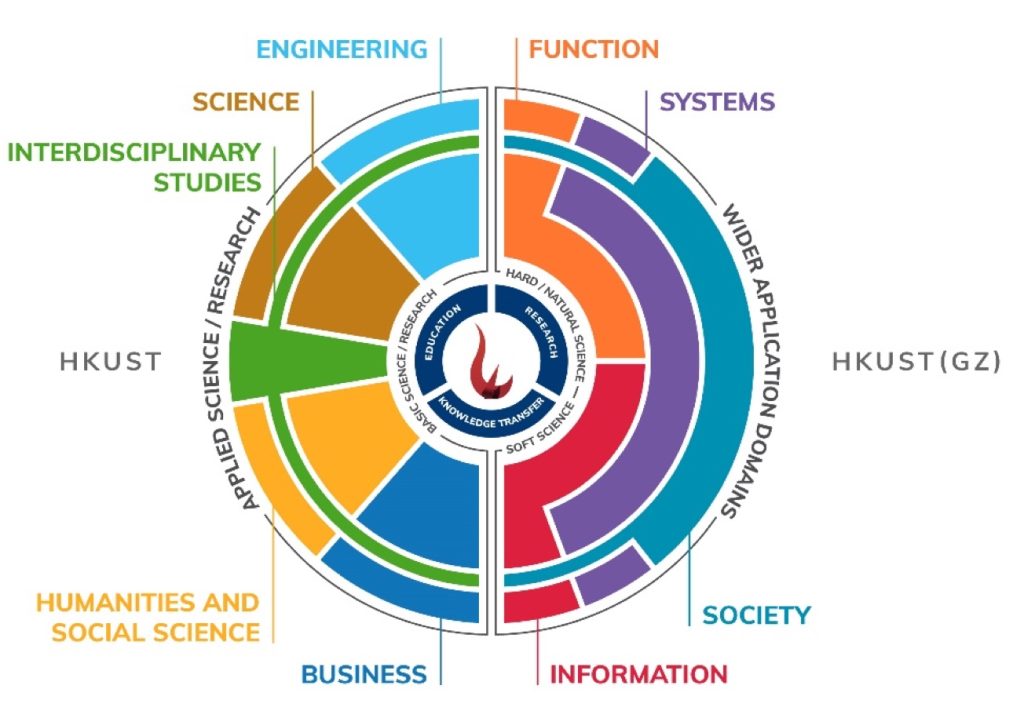
Buttressed by the rigorous commitment to cross collaboration in academic disciplines in Clearwater Bay campus, HKUST(GZ) will advance the concept of an interdisciplinary platform to the next level. On the solid foundation built in the Schools/AIS, the Guangzhou campus comprises four Hubs that serve as nexus among disciplines. Under each Hub, there are a few Thrust Areas which represent the key emerging areas for directions and foci of research. These non-conventional Hubs of Function, Information, Systems, and Society and their Thrust Areas strive to cut across disciplinary and organizational boundaries, emphasize interaction and synergy, and create holistic knowledge beyond disciplines.
All research postgraduate students will be co-supervised by at least two supervisors from different disciplines. This mandatory requirement is to ensure the cross-disciplinary thinking in research topics. When the faculty strengths in the new campus are in place, one supervisor will be from HKUST(GZ), while the other supervisor may be from another Thrust Area in HKUST(GZ), or HKUST Clearwater Bay or from an external organization.
While Function and Information work together and provide the fundamentals to build Systems that supports Society, the Hubs are all interconnected to ultimately bring impact to the community. A cycle that facilitates recursive advancement is formed where the feedback from the community returns to Systems via Society and reaches Function and Information. These Hubs complement the four pillars of academic strengths established by the Schools in Clearwater Bay to show fast response to new problems and needs, thus making significant impact on the non-academic communities.
Hubs and Thrust Areas
HKUST(GZ) starts to offer world-class undergraduate education in 2023.
HKUST(GZ) adopts the Hub structure which facilitates Cross-disciplinary Education, Research and Knowledge Transfer. Combining hard, natural and soft sciences, each of the four Hubs comprises a few thrust areas. Central to the academic framework is the enquiry-based cross-disciplinary active learning model which blends enquiry-based and problem-focused experiential learning.
The academic structure is planned to be sufficiently agile so as to respond promptly to the needs and challenges of the rapidly changing world. While the four Hubs will remain for a longer time, the Thrust Areas will be reviewed on a timely basis. The resulting model below reflects the actual needs of the real-world problems, giving no rigid disciplinary boundaries for the thrust areas as they keep evolving and not belonging to just one particular Hub.